What is my research about?
My area of research is a field of pure mathematics known as algebraic geometry. Specifically, I study a class of structures called algebraic surfaces, which are two-dimensional geometric objects defined by polynomial equations.
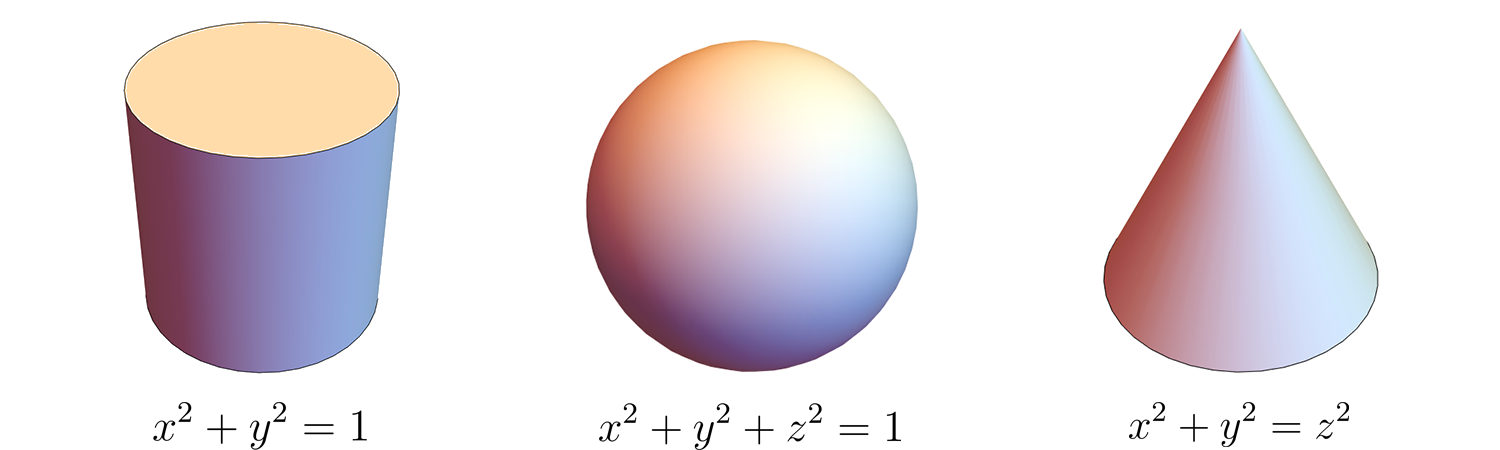
The cylinder, the sphere and the cone are all algebraic surfaces as they can all be represented as sets of points in space whose coordinates \((x,y,z)\) satisfy a polynomial equation.
As a geometer, I am interested in analysing which properties these surfaces share and which properties allow us to tell them apart. For instance, there is a clear difference between the sphere and the cone. While the surface of the sphere is smooth and uniform, the cone has a pointy tip, which is what we call a singular point. Surfaces without singular points, like the sphere, are called smooth surfaces, whereas those with singular points, like the cone, are called singular surfaces.
I specialise in studying the singular points of a particular class of surfaces known as K3 surfaces. These surfaces are of interest not only to mathematicians but also to physicists, as they play a key role in certain formulations of string theory.[1] In particular, my research focuses on a class of K3 surfaces with multiple singular points, known as generalised Kummer surfaces.
In general, finding surfaces with many singular points is a challenging problem. One fruitful approach involves examining the possible symmetries of simpler surfaces. For example, consider the symmetry of the plane that rotates all points by an angle of 180° around a point.
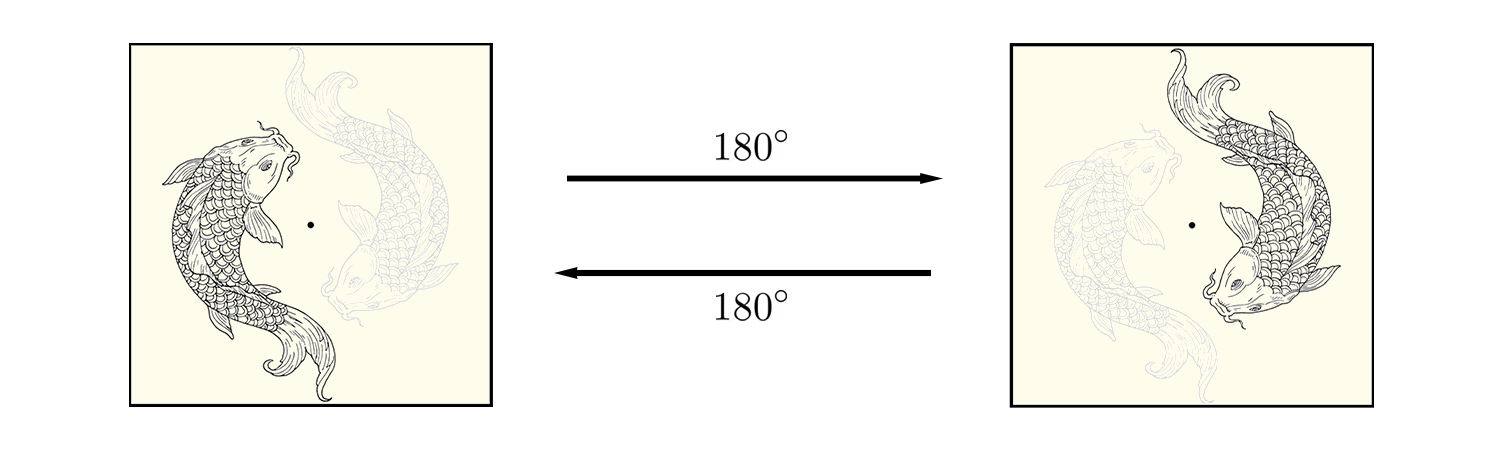
If we identify the points in the plane that are related by this rotation, the resulting surface is a cone, where the rotation’s fixed point corresponds to the singular point.
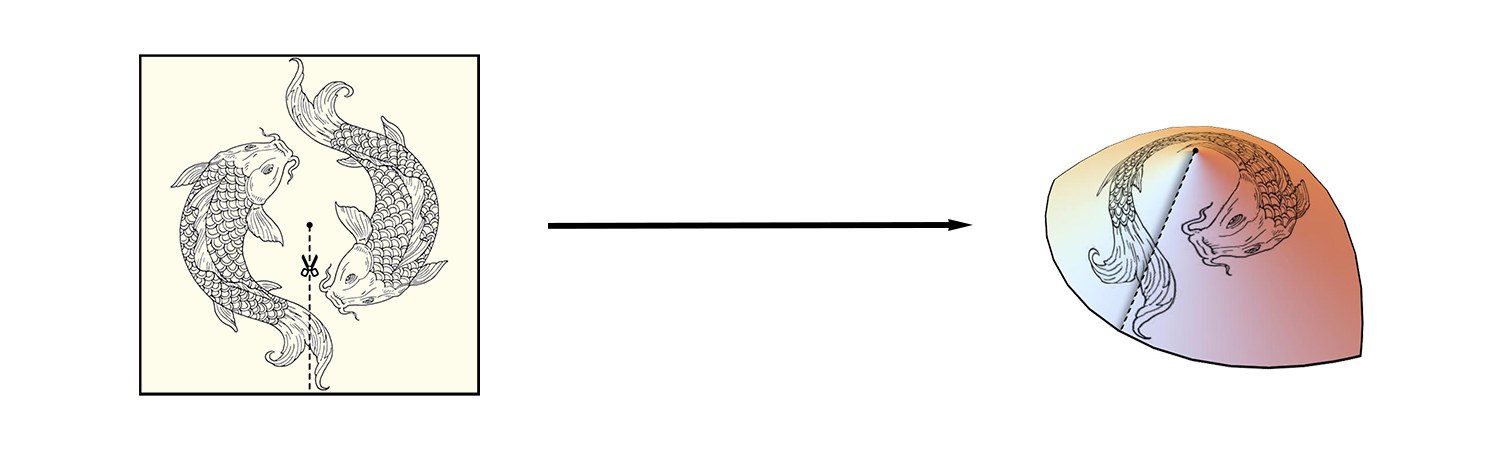
In this case, we say that the cone is the quotient of the plane by a 180° rotation. Similarly, the generalised Kummer surfaces I study are quotients of a class of surfaces called abelian surfaces.
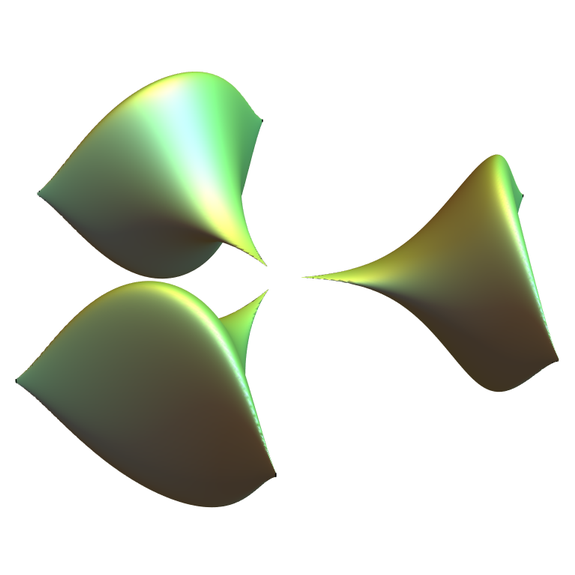
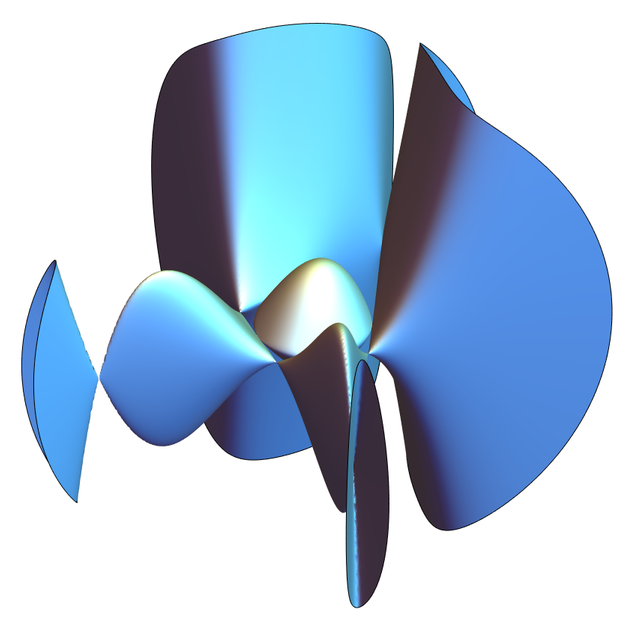
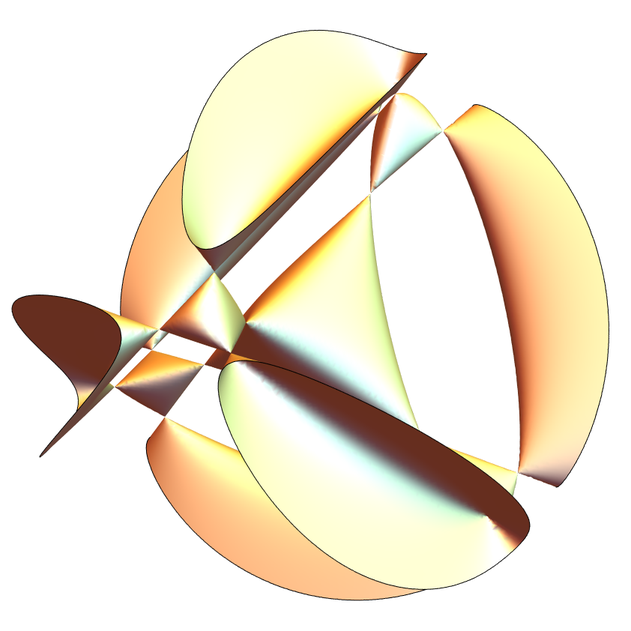
Examples of generalised Kummer surfaces with 9, 10 and 16 singular points.
How many singular points can a generalised Kummer surface have, and how intricate can they be?
Since Kummer surfaces were first described in 1833, this question has attracted the attention of many mathematicians. In 1987, Toshiyuki Katsura provided a classification of the number and types of singular points of generalised Kummer surfaces.[2] However, Katsura’s classification was incomplete: while it held for surfaces defined by polynomials with complex coefficients, it did not extend to a setting called positive characteristic.
Positive characteristic geometry studies geometric objects defined over number systems in which arithmetic is performed modulo a fixed prime number \(p\), for example, \(p = 2, 3, 5\) or \(7\). This is similar to clock arithmetic, where numbers “wrap around” after reaching \(12\). In these number systems, the arithmetic is quite surprising — for instance, \(1 + 1 = 0\) and \((a+b)^2 = a^2 + b^2\) when \(p = 2\). This changes many geometric properties, often making features of surfaces like singularities and symmetries behave in fundamentally different ways from the classical setting, which is known as characteristic zero.
Sergey Rybakov recently made progress in the classification in positive characteristic, complete classification of all possible singular points of generalised Kummer surfaces in positive characteristic.
One reason researchers are interested in positive characteristic geometry is that many problems are simpler in this setting. This is because, unlike in characteristic zero — where surfaces typically contain infinitely many points — surfaces in positive characteristic usually have only a finite number of points. These points encode important information about the geometry of the surface and can be studied efficiently using numerical methods.
Given a smooth surface \(S\) in characteristic zero, there is a process called reduction modulo \(\mathfrak{p}\) that produces a surface \(S_\mathfrak{p}\) in positive characteristic. If \(S_\mathfrak{p}\) is also smooth, we say that the surface has good reduction at \(\mathfrak{p}\). Here, the letter \(\mathfrak{p}\) stands for prime, because the possible ways of constructing these reductions are naturally associated with prime numbers. If \(S\) has good reduction, then \(S\) and \(S_\mathfrak{p}\) share similar geometric features, so this provides an additional perspective for understanding surfaces in characteristic zero.
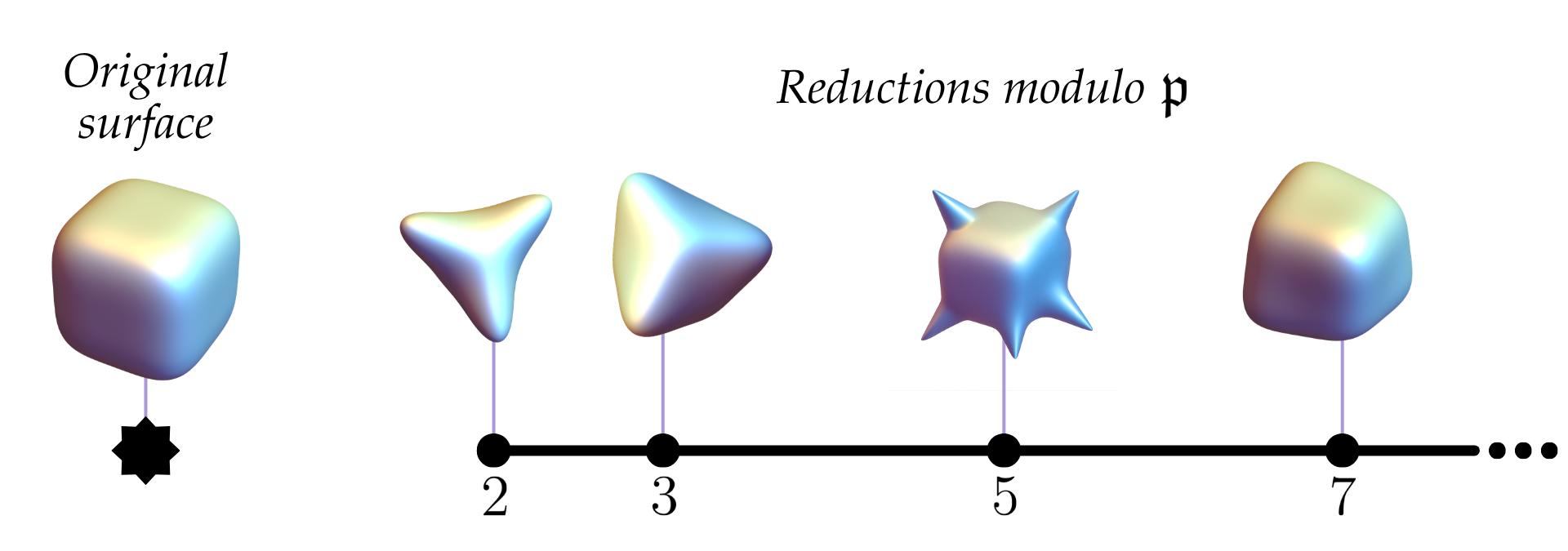
In this example, the surface has good reduction at \(\mathfrak{p} = 2, 3\) and \(7\), and bad reduction at \(\mathfrak{p} = 5\).
If a surface has good reduction at all primes, it is said to have everywhere good reduction. These surfaces are extremely rare, and the few examples that we know are quite elaborate. In the paper Explicit desingularisation of Kummer surfaces in characteristic two via specialisation, I described the first known examples of K3 surfaces with everywhere good reduction.[3] To give a sense of why such examples had not been discovered before, note that in 1990, Abrashkin proved that there are no K3 surfaces with everywhere good reduction whose equations have rational coefficients.[4] To obtain these examples, I had to develop new techniques to analyse the reduction of K3 surfaces and employ computational methods to implement them.
During my PhD, I have also made contributions to the understanding of a class of geometric structures known as moduli spaces. Informally, these can be understood as follows. Suppose one wishes to study a collection of geometric objects — for example, triangles. If the collection satisfies certain conditions, one can associate a moduli space to it, which is a geometric structure whose points correspond to objects in the collection, arranged so that similar objects are represented by nearby points.
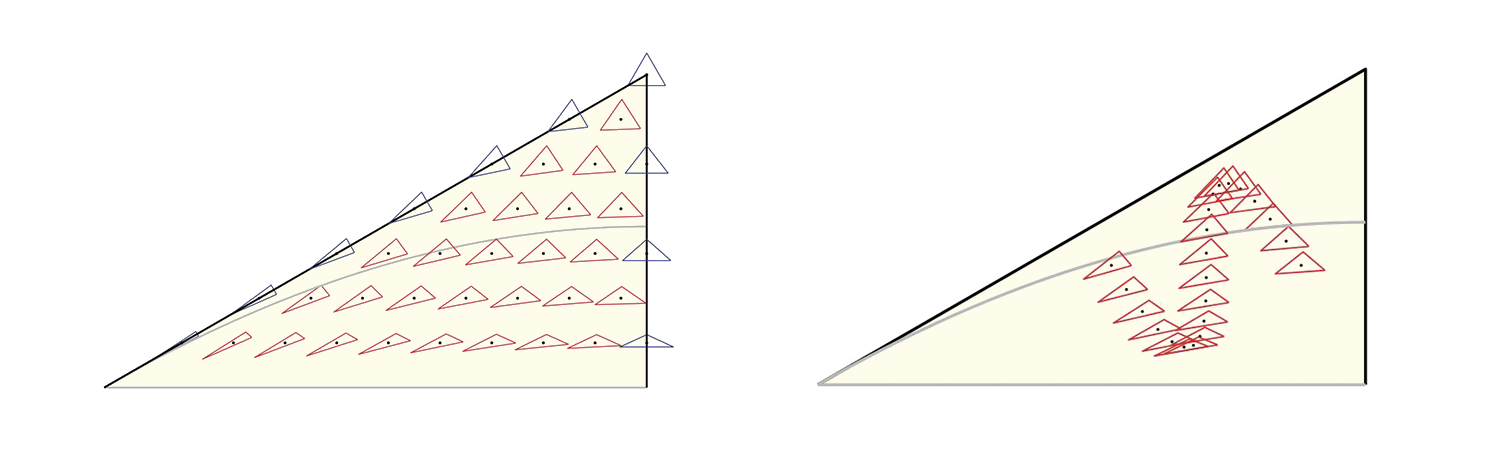
I am interested in the moduli space that parametrises objects called genus two curves. These curves are connected to my research because they can be used to construct abelian surfaces, in such a way that the symmetries of the curve induce symmetries of the surface. In the paper Intersections of the automorphism and Ekedahl–Oort strata inside the moduli space of genus two curves, I gave a description of this moduli space in positive characteristic.[5] The main result is that this moduli space is three-dimensional and admits a decomposition into lower-dimensional pieces, called strata, which correspond to families of curves with special properties.
As a researcher working in pure mathematics, it is often difficult to anticipate what possible applications your area of research may have. In my case, however, there is a clear connection between positive characteristic geometry and cryptography. The abelian surfaces I discussed earlier are a generalisation of another geometric object called elliptic curves, which are widely used in cryptographic applications.
Elliptic curve cryptography is a standard method for securing Internet connections and end-to-end encrypted messaging, but it is unfortunately vulnerable to potential quantum attacks. This has prompted interest in developing new algorithms that will remain secure in the era of quantum computers. One of these protocols involving elliptic curves, called Supersingular Isogeny Diffie–Hellman (SIDH), was considered secure until 2022, when Castryck and Decru described an attack that exploits abelian and Kummer surfaces in positive characteristic to recover encoded information.[6]
References
- P. S. Aspinwall, "K3 surfaces and string duality," in Theoretical Advanced Study Institute in Elementary Particle Physics (TASI 96): Fields, Strings, and Duality, pp. 421–540, 1996. arXiv:hep-th/9611137.
- T. Katsura, "Generalized Kummer surfaces and their unirationality in characteristic \(p\)," Journal of the Faculty of Science of the University of Tokyo, Sect. IA, Math., vol. 34, pp. 1–41, 1987.
- A. Gonzalez-Hernandez, "Explicit desingularisation of Kummer surfaces in characteristic two via specialisation," Journal of Symbolic Computation, vol. 135, p. 102541, 2026. DOI: 10.1016/j.jsc.2025.102541.
- V. A. Abrashkin, "Modular representations of the Galois group of a local field, and a generalization of the Shafarevich conjecture," Mathematics of the USSR-Izvestiya, vol. 35, no. 3, pp. 469–518, 1990.
- A. Gonzalez-Hernandez, "Intersections of the automorphism and the Ekedahl–Oort strata in \(M_2\)," arXiv, 2025. arXiv:2507.07278.
- W. Castryck and T. Decru, "An efficient key recovery attack on SIDH," Cryptology ePrint Archive, 2022. eprint.iacr.org/2022/975.